

The Memory Tax: What Forgetting Costs Your Timesheet
Memory-based time tracking is wildly inaccurate. Here is what that costs you — and the simple fix.
The Memory Tax: What Forgetting Costs Your Timesheet
Try this: without checking anything, list every meeting you attended on Tuesday. Then add the focus blocks. Then add the two unplanned calls that ran 20 minutes each.
Most people lose between 30 and 90 minutes of accurate recall by the time Friday arrives. We call it the memory tax — the hours you actually worked but cannot prove.
Why this matters more than it sounds
A small daily inaccuracy compounds quickly:
- Underbilling — freelancers leave 4-7% of revenue on the table each month
- Skewed planning — managers staff projects based on numbers that were guessed
- Compliance risk — audited timesheets need defensible entries, not vibes
The honest fix
Stop relying on memory. The calendar you already use is a perfect, time-stamped log of your week. The meeting that ran from 2:14 to 3:02 PM is right there. The 11 AM standup that took 7 minutes is right there.
Stintt reads that record and turns it into a timesheet. You stop reconstructing and start reviewing.
What this looks like in practice
- Connect your calendar (Google, Outlook, Teams, iCal — any of them)
- Optionally connect Jira, Zoom, Asana, ClickUp for non-meeting work
- Open the app on Friday — your week is already filled in
- Adjust anything that looks off, then export
What you cannot get from a stopwatch
Timer apps still leave gaps because nobody starts a timer for the call that interrupted them. Calendar-based capture sees the call regardless. That is the entire difference.
A small invitation
Your week was hard. The record of it should not be.
Connect your calendar → and see your last seven days, already organized.
- See how Stintt builds automatic timesheets from Google Calendar
- Set up the Google Calendar timesheet integration
- Try the free timesheet calculator
- Compare plans on Stintt pricing
Related articles

Free Timesheet Templates for Freelancers 2026
Download free timesheet templates designed for freelancers in 2026. Excel, Google Sheets, and auto-generated options — plus a smarter alternative that fills itself.
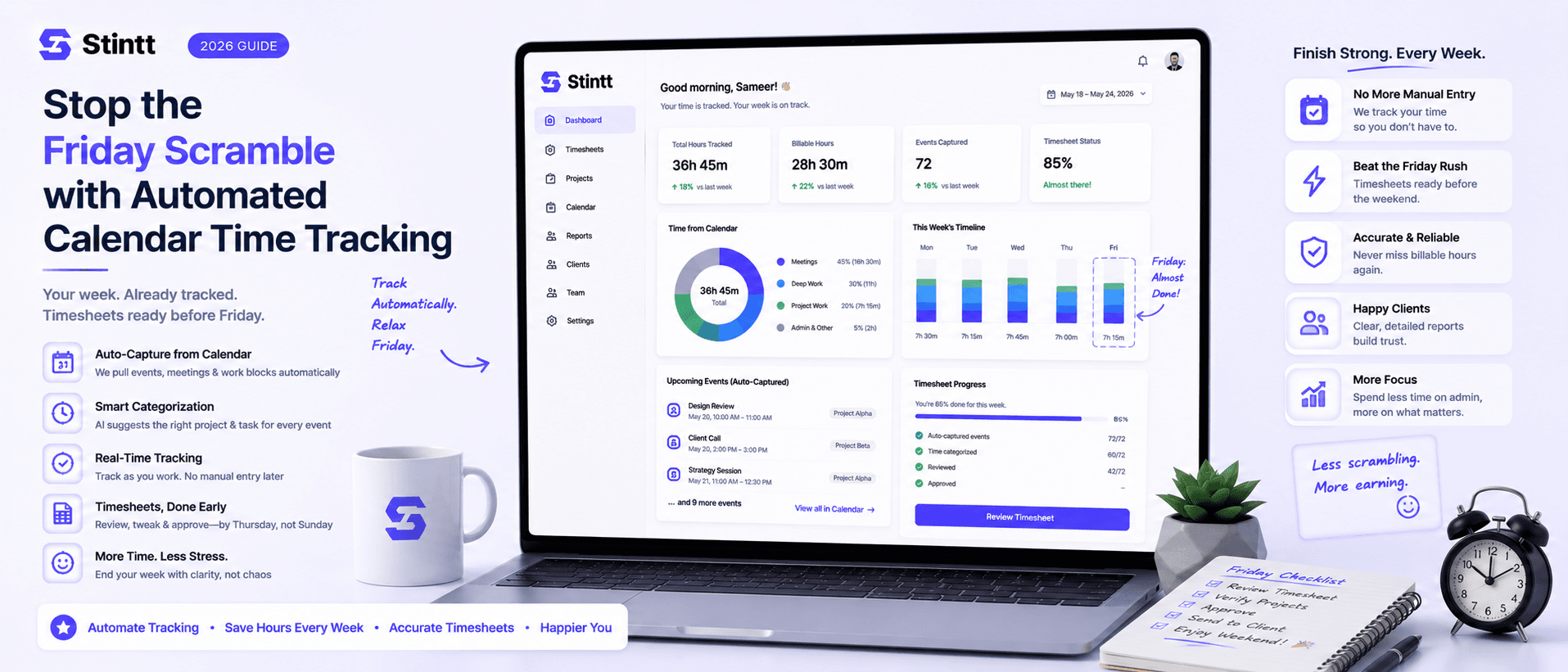
Stop the Friday Scramble with Automated Calendar Time Tracking
Automated calendar time tracking takes the events already sitting in your team's Google Calendars and turns them into drafted timesheet entries each person reviews and approves. Nobody reconstructs a week from memory at 4pm on Friday, and you stop spending Monday chasing the people who never submitted. Here's what the Friday scramble really costs, how calendar-based tracking closes the loop through to invoices, and where it's the wrong fit.
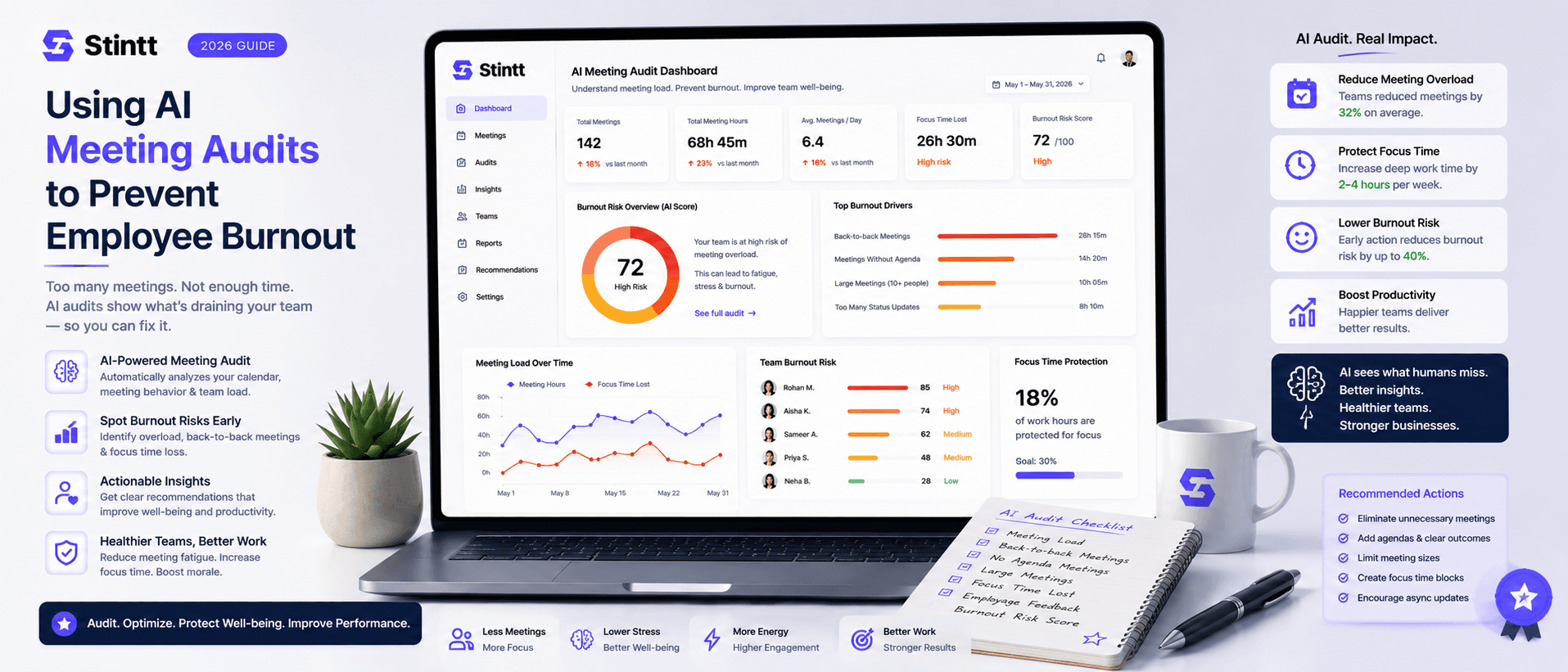
Using AI Meeting Audits to Prevent Employee Burnout
The average professional spends nearly 13 hours a week in meetings — about 84 working days a year — and constant context-switching quietly drains 20% of their mental capacity. At some point a packed calendar stops being busy and starts being a burnout risk. An AI meeting audit reads the calendar your team already keeps and gives you an honest split of meeting load versus focus time, early enough to rebalance workloads before people quit. Here's how it works, the frameworks that make meetings earn their place, and how to gather the insight without tipping into surveillance.